When a big tree on your property has to come down, the company you choose matters more than almost anything else. These jobs mean lowering sections that can weigh several thousand pounds each over your roof, your fence, and maybe your kids’ swing set, so you need a crew you can trust. Before you hire anyone to help with your large tree’s removal, look for four things: a current license, liability and workers’ compensation insurance, trained arborists, and the right equipment for your yard.
Why Large Tree Removal Is a High-Stakes Job
Deciding to remove a big tree is rarely easy, whether it’s been part of your yard for decades or a storm has left it leaning dangerously close to your home. Either way, you want it down safely, with no damage and no surprise charges. Large tree removal is one of the trickiest jobs in tree care, and it leaves no room for a crew that’s guessing.
It’s also dangerous work for the people doing it. The Tree Care Industry Association tracked 243 tree care deaths in the U.S. from 2020 through 2023, about 61 every year, and estimates the industry’s fatality rate may run as high as 11 times the all-industry average.
Did You Know?
If something goes wrong, the cost can land on you. University of Georgia Cooperative Extension points out that you can sometimes be held financially responsible if an uninsured worker gets hurt on your property or damages your neighbor’s.
What to Look for in a Large Tree Removal Company
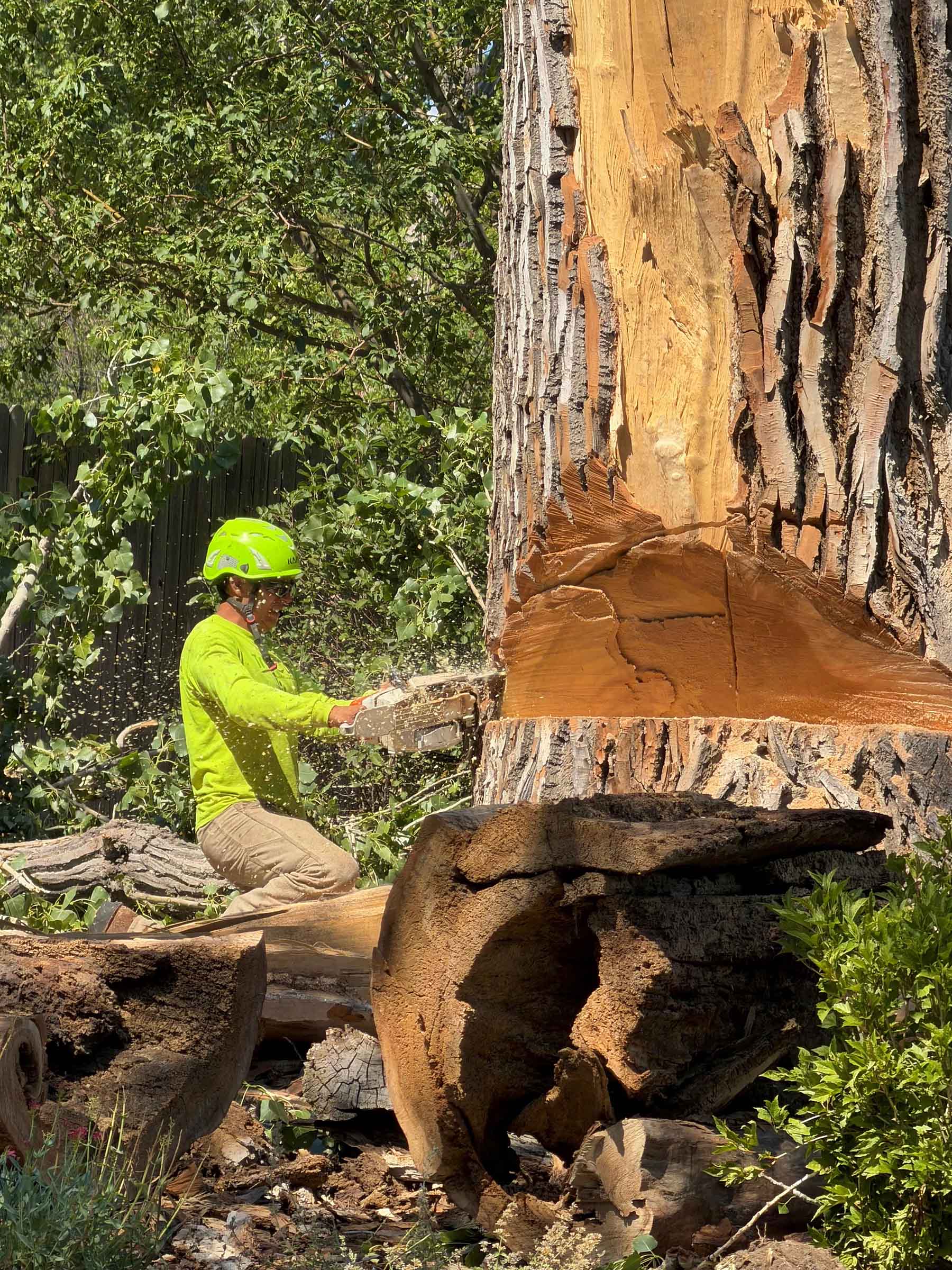
Vetting a large tree removal company doesn’t take long if you get your ducks in a row first. Asking a handful of questions questions up front can save you a lot of heartache.
Here’s what we’d check if it were our own home.
1. Proof of Local Licensing
In Denver, anyone who prunes or removes trees has to be licensed as a tree service company, and the city keeps a licensed contractor list you can check in minutes. This is an easy way to weed out unqualified crews before they set foot in your yard.
2. Liability and Workers’ Compensation Coverage
You’ll want proof of two kinds of insurance. General liability covers your house, fence, or car if a limb lands somewhere it shouldn’t, and workers’ compensation covers the crew if someone gets hurt. Most large tree removal projects involve climbers, ropes, and heavy machinery at the same time, so both policies should be active the day the crew arrives.
Ask for Certificates Straight From the Insurer
Ask the company’s insurance agent to send the certificate straight to you, a step NC State Extension recommends for homeowners so you know the coverage is current.
3. Trained Arborists Who Follow Safety Standards
Ask whether the crew includes International Society of Arboriculture (ISA) members and follows ANSI Z133, the safety standard arborists wrote for their own industry. The current edition is ANSI Z133-2026, and while following it is technically voluntary, the Tree Care Industry Association notes it carries the force of law in many situations across the U.S.
4. Equipment Matched to Your Property
Every yard is different, and yours will shape how the tree can come down safely. A good company will explain which approach fits and why:
- Felling: The tree comes down in one piece, which only works with a clear landing zone longer than the tree is tall.
- Rigging and lowering: A climber cuts the tree into sections while the ground crew lowers each piece with ropes, a good fit for many backyard trees.
- Crane-assisted removal: A crane holds each section before it’s cut and lifts it over your house, ideal for decayed trees or limbs over the roof.
Tree Tip
If your tree is tucked behind the house or leaning over a structure, a crane tree removal service is often the safest way to go.
5. A Clear, Itemized Estimate
Every large tree removal is priced a little differently, because the cost depends on the tree’s size, its condition, and how close it sits to your house. A good estimate explains how those factors shape the price and lists everything included, from hauling to stump grinding. We hold ourselves to one simple rule on every tree removal service in Lakewood and across the Denver metro:
“Expect a clear, itemized estimate up front and a full cleanup at the end.” TreeCuts
Storm Damage Tree Removal and Other Colorado Challenges
Colorado weather is notoriously unpredictable, and our trees often pay the price. A heavy, wet spring snow can arrive after branches have already leafed out, and the extra weight cracks limbs and splits trunks. Once a tree is damaged like this, the wood can shift unexpectedly as it’s cut. Storm damage tree removal calls for experienced climbers who can read the tension in a broken limb before making a single cut.
Did You Know?
Pests are part of the picture, too. The Colorado State Forest Service reports that emerald ash borer spread across the Front Range in 2025, with new detections in Denver, Golden, and Wheat Ridge. Ash trees make up about 15% or more of Colorado’s urban trees and usually die within two to four years once infested, so many Front Range homeowners now need large tree removal for trees they hoped to keep for decades.
Red Flags to Watch for Before You Hire
As you talk to different companies, keep an eye out for these red flags:
- Someone knocking on your door the morning after a storm
- Pressure to sign or pay that same day
- Hemming and hawing when you ask for insurance certificates
- A request for a big cash deposit before any work starts
- A quote that never mentions cleanup, hauling, or stump grinding
Go with your gut! Remember, a reputable crew who has your best interests in mind will always be happy to help with any questions you have.
Find Trusted Tree Removal in Denver With TreeCuts
Taking down a tree you’ve lived alongside for years is a big step, and you deserve a team that treats your property like their own. We’re a family-owned company with tree service and arborist licenses in Denver and surrounding jurisdictions, ISA members on our crew, and a promise to leave your yard clean when we’re done. Whether you need help with large tree removal, routine tree services for homeowners in Colorado, or tree removal in Denver after a rough storm, we’d love to help. Call us at (303) 731-1390 or request a free quote to get started.